Friday, December 9, 2011

The Chenchu Country


Nalamalla Hills are home to the Chenchu tribe. They have been its guardians since time immemorial and it has sustained them to this day. But the romanticism associated with the notion of a simple life sits in stark contrast to the harsh realities of grinding poverty and destitution that form the daily experience of the Chenchus. Today the Chenchus are a shadow of their former selves.

During the last week of November our team of wildlife photographers, outdoor enthusiasts along with a small documentary crew ventured on a journey into the northern tracts of the Nalamalla forests past Mannanur in Mahbubnagar district (140 kms from Hyderabad). In our quest to reach a Chenchu settlement, we ended up hiking deep inside the Farahabad Tiger Reserve - home to panthers, monkeys, bears and of course tigers.

After a 12 km jeep ride inside the reserve, we were informed of a settlement that can only be reached by foot. The hilly path leading to the settlement was littered by pug marks and droppings of carnivores and pits dug by sloth bears - the group decided then and there to stick together. The end of the 6 km march through the deciduous jungle was marked by the menacing howls of the semi-wild dogs that signals the proximity of a Chenchu village. We had reached Bhiarapur Penta.

Bhiarapur Penta is situated next to an ancient temple on the banks of a small man-made lake. Katraju, the Chenchu ‘pedda manishi’ or headman of the village tells us that their village lies on the old forest pilgrim path to Srisailam used before the time of roads. This also signifies constant contact with the wider society explaining the prevalence of Shaivism in the area.


The village itself was spread over a wide area with the huts spaced out - apparently to avoid brawling after drinking. On visiting individual huts, we inevitably find someone ill. Fevers are a running theme here and the frail bodies of the Chenchus do not offer much resistance. Slowly the hardships of the Chenchus unravel before our eyes - they do not practice agriculture and are not allowed to hunt, their kids have to walk for miles through the forest to get to and from school, they depend on the government for food-grain and pulses. The threat of being relocated from their home plays on their mind and they do not believe they can survive outside their forests.

We left Bhairapur Penta after a day spent among the Chenchus - all the while reminded of contrasts and commonalities that we held with them. On the jeep ride out of the reserve, we met a Chenchu man employed by the forest department as a wildlife spotter. After the spotter had shown us his skills with his bow and arrows, one of our group members struck a conversation with the spotter, cheekily asking the him if it would be alright if one of us were to marry a Chenchu girl. The spotter instantly got annoyed and retorted “evari kulam lo valu undali” (“a person should stay within his community”) before curtly parting with us. We had finally met the Chenchu.


(Written for University Monthly - Osmania Courier and therefore the content & tone)

Thursday, October 20, 2011

Not Willing


This photograph of is from a Pune-Hyderabad flight from yesterday. Generally airlines won't ask passengers to open doors, but when they do (especially emergency doors) - it may not be the best time to express reservations.


(Closer Look)

Still, the third category of ineligibles for filling a particular seat next to the exit is baffling -

"Persons who are not willing to open the Exit"

Some common problems with such instructions:
  • How does one identify such an individual, does the cabin-crew ask?
  • Is previous experience in such door-opening activities necessary?
  • Does such a passenger get compensation/air-miles for his emergency-doorman duties?
  • What if the plane is full and no one is willing?
  • What if the only "willing" passenger wants an isle seat?
  • What happens if the passenger changes his mind after initially consenting?
  • What if the passenger is "willing" but not able to figure it out?
  • On what cue does the passenger open the exit? For eg: When he hears a Doorbell perhaps?
  • What if the exit is opened but there is no emergency? Does the passenger retain his seat?
  • What if the passenger is overly enthusiastic about opening the exit - is that a cause for concern?
and so on.

(Photography: Dr. Vijay)

Wednesday, September 21, 2011

Energetic Panel

This morning moving solely on an impulse for Ghee Idlis served at Purna Tiffins in Krishna Nagar, we started from my place at 10 and made our way through Film Nagar. There we were hit in the face by a colossal hoarding placed strategically on the foot-overbridge opposite the Film Nagar Cultural Centre/Club (FNCC). It was a campaign billboard for the upcoming elections to the FNCC. If ever there was a way to make sure your constituents memorized your face (and the faces of everyone of your proposed "energetic panel" in the order of their importance/portrait size), this was it.


After getting our quota of idlis, we headed back to base. But the traffic began to clog at Jubilee Hills Checkpost and sure enough it was because of the most common cause of traffic jams in Hyderabad - one Mr. Harish Rao. The protesters were fired up and we were filled up - no contest. So we took detour after detour and in due time got back.

I guess the common thread between the two experiences was politics. The Film Nagar Society membership costs upwards of Rs. 25 Lakh and has a waiting period of over 10 years and therefore their members-only annual elections are literally and allegorically "above the road" on which common people commute. The street protests by the Telangana activists on the other hand was very much "on the road".

Though the real common thread of it all is my undying affection for good food. Again, both literally and allegorically.

Monday, July 4, 2011

Duplicate Police

In Secunderabad today on the tiny traffic island between MG Road and RP Road, I came across a hoarding that stood out. There were around 50 faces neatly packed into tiny cells each looking stoically into the camera. The title at the top read -

WANTED
NAKILI / DUPLICATE POLICE


Looking at all those men holding black slates with illegible chalk marks, it could only mean that they were either failed Zilla Parishad school students or hardened criminals. And the message was from the police. So putting two and two together, we can deduce that the Secunderabad Police is looking to hire school dropouts into their "Nakili/Duplicate Police" force. Or their desperation to recruit has reached a stage where they are compelled to reach out to ordinary commuters stuck in the middle of traffic clogs to fill these vacancies.

On the other hand, it may simply be the case that the police can't handle the competition from petty criminals. Meanwhile the "real" police (traffic) continued to "serve" the citizens down the road by making the load in the commuters' pockets a little lighter.

Monday, June 13, 2011

Lighting Up The Lives


Hyderabad based Thrive Energy Technologies sells and distributes this LED portable home light, which has been one of the more visible LED lighting products around. To complete the brand building exercise they gave their product a fancy sounding name - "Accendo". And finally the great minds at Thrive came up with this disturbingly arsonist tagline -

LIGHTING UP THE LIVES
in Villages, Forests & Towns"

I own one of their lights (in photo), luckily though I escaped their pyromaniacal designs by simply living in a city.


Link:
http://www.thrive.in/led_lighting/led_home_lighting.htm


Tuesday, June 7, 2011

Xtra

ESPN is showing reruns of the American National Spelling Bee contest where kids have to spell some really tough words to win. This year for the nth time for whatever reason, it's yet another Indian-origin girl who won.

How is spelling a sport? What sort of a kid craves to participate in such a contest? Why does the judge ring a bell for each wrong spelling, instead of, say, whistle? - I do not know. But I do remember seeing a promo for an Indian version a few months ago on a sports channel. I guess the idea is that with such great spelling ability, these kids are set for big things in life. Not so, not in India.

India is really the only country in the world where people actually make good money for spelling/not spelling words (excluding Quentin Tarantino for 'Inglourious Basterds'). And they call themselves 'numerologists' here. These select individuals ply their trade by spelling simple words wrong. Initially it was limited to the vernacular language words written in Roman script, but now our specialists have gone international, by acquiring (read shedding) enough skills to go after English.

Our guys are the Picassos and MF Hussains of spelling, because if all you do is spell things correct then you are just not doing justice to your creative talent. Those spelling kids though still do have one advantage - they know the correct spellings and consequently are an authority on all the wrong ways to spell. This crucial knowledge could be their meal ticket.

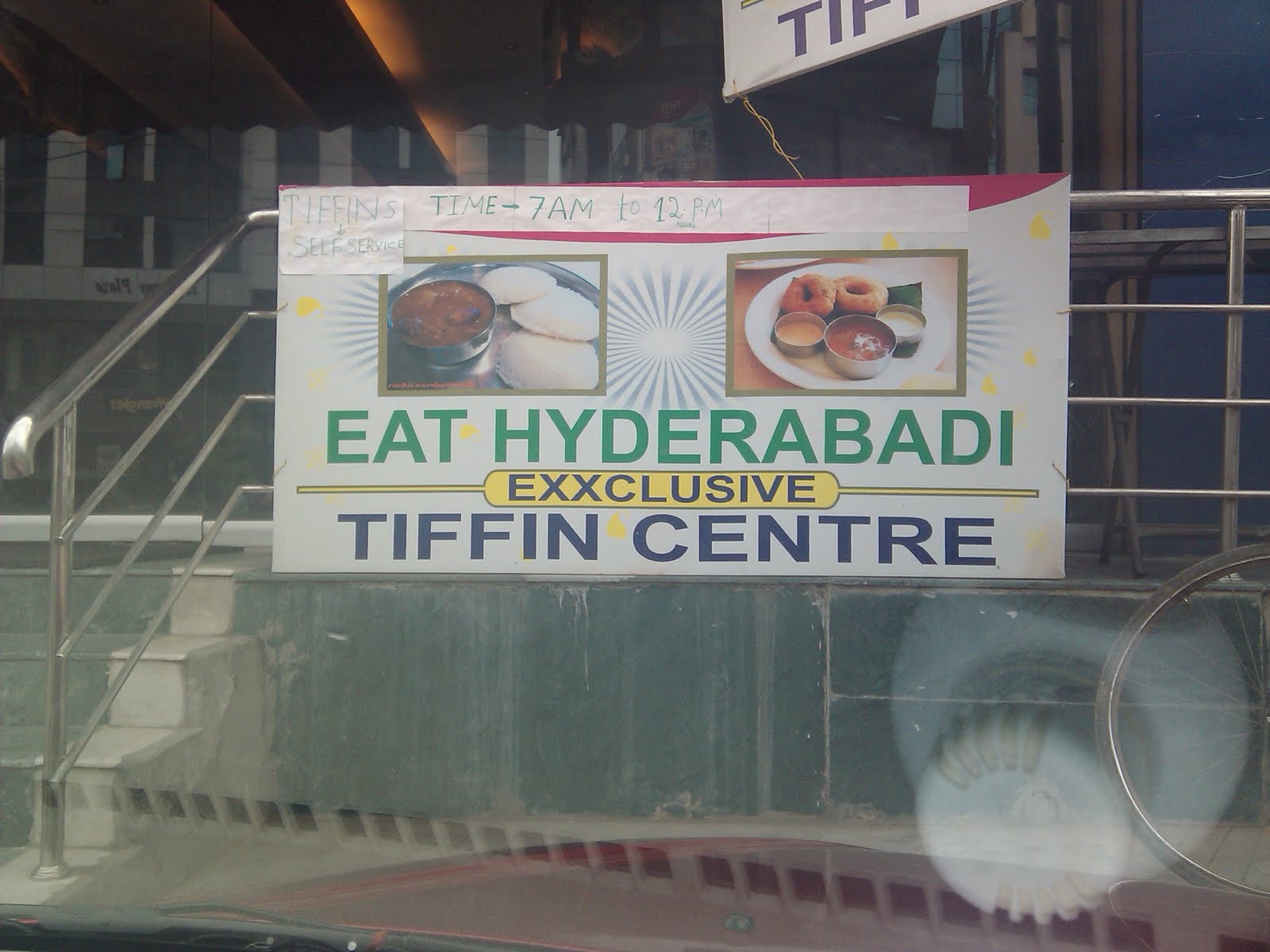
Therefore here we have yet another exhibit of absolute genius from 'Eat Hyderabadi' in Himayatnagar. Notice how they carefully chose the letter X for repetition to give the customer that reassuring feeling of being really, really alone while performing "tiffin self-service".


Disclosure: Spell Check Used

Saturday, May 28, 2011

Arbitrary Powers

Today there were two interesting bits of news that were reported from Kolkata and London which focused on negligence in the health and social services and corrective executive action. The first article was about a visit by the new Chief Minister of West Bengal, Ms. Mamata Banerjee to a hospital as an inspection tour and her confrontation with the hospital director who did not take kindly to the unannounced visit. Then the second article was about Ed Balls (the then Health Secretary of State for Children, Schools and Families in the UK) sacking the local head of Child Services publicly in 2008 over the death of a 17 month old boy. Subsequently, the court has agreed that the action was unlawful.

Although the Bengal story may not have ended, it seems to be on the same path as the British incident. The two stories converge in the fact that the top political executives view the bureaucrats as guilty parties straight away and by exorcising these personnel from the system, they hope to make things right. And in a naive sense, they do establish their authority and potency but fail to really create a tangible difference. In the British case, there is talk of suing for damages which will act as a deterrent to the government. But in Bengal, on the back of a game changing election, there is little to check the actions of the executive.

After the Left government was defeated in West Bengal, Ms. Banerjee has taken over the reigns and is learning the ropes of direct power. And she started out by doing what Mr. Chandrababu in Andhra Pradesh and Ms. Jayalalitha in Tamil Nadu did when they were previously Chief Ministers. She is hitting on the obvious targets first by launching an inquisition against the people manning the system. That move, although popular, may not be the best advised route since both Babu and Jayalalitha lost in the subsequent elections from a government employee-led backlash. But more than just the political fallout of finding fault with the system, the chief executives have to realize the value in being correct in what they do, both popularly and legally or risk the non-cooperation of their subordinates who will throw the book at new initiatives.

Links:
1. http://www.mumbaimirror.com/article/3/20110527201105270336326472fc7cba1/Didi%E2%80%99s-hospital-visit-sparks-%E2%80%98sick%E2%80%99-wordy-duel-with-boss.html
2. http://www.guardian.co.uk/society/2011/may/27/sharon-shoesmith-court-win-baby-p

Tuesday, May 17, 2011

Threat Perception


Today, on the roads I came across this evangelist's vehicle with a "for any prayer request" call sticker on its rear window. It also featured the following eerie verse from the bible (in upper case,bold and underlined in red!) :

"PREPARE TO MEET THY GOD"

With this disconcerting message stickered on the burly vehicle, it sort of felt like a direct threat to the safety and well being of fellow motorists and pedestrians who were to get in its way. And in the context, the prayer call request made more sense as one final opportunity to beg for mercy!

Thankfully I kept my distance and we parted ways without incident. Praise the Lord.

"Therefore thus will I do unto thee, O Israel: and because I will do this unto thee, prepare to meet thy God, O Israel. "
-Amos 4:12, Bible


Road Movie Links:
Duel: http://en.wikipedia.org/wiki/Duel_%281971_film%29
Death Proof: http://en.wikipedia.org/wiki/Death_Proof
Joy Ride: http://en.wikipedia.org/wiki/Joy_Ride_%282001_film%29

Wednesday, May 11, 2011

Doggone Strikes Back

Puppy (aka Canny) is back, at least in spirit. It has been a year since the last obituary and like clockwork the insert on page 10 of the Times of India (Hyderabad Edition) today again has the same eulogy, photo, contact details, breed, DoB and ofcourse the same DoD.


Monday, May 2, 2011

Not Wealth Or Power


In his speech today, announcing the death of Osama Bin Laden, US President Barack Obama said something that was cut from most of the news broadcasts. It came right at the fag end of the 9 minute speech and as such has little significance in relation to the gravity of situation. Taken by itself, it may seem like just another platitude. But these messages within messages are put out there for a purpose, they serve to reaffirm the tenets of a nation (highlighted in red below). They are meant to convey, in this case, a sense of consistency and justice and thus their righteousness.

Excerpt:

"The cause of securing our country is not complete. But tonight, we are once again reminded that America can do whatever we set our mind to. That is the story of our history, whether it's the pursuit of prosperity for our people, or the struggle for equality for all our citizens; our commitment to stand up for our values abroad, and our sacrifices to make the world a safer place.

Let us remember that we can do these things not just because of wealth or power, but because of who we are: one nation, under God, indivisible, with liberty and justice for all."


Link:
Text of the Speech: http://www.telegraph.co.uk/news/worldnews/barackobama/8487354/Osama-bin-Laden-killed-Barack-Obamas-speech-in-full.html
http://en.wikipedia.org/wiki/National_character_studies

Monday, April 25, 2011

A Fire Today...


Rajahmundry airport observed fire service week this past week. The passengers were informed the same through this note. But the note itself seemed more directed toward the staff and their concern of holding down a job after a fire accident. Mundane side-stories such as typing errors, safety or survival were avoided in this crisp circular as it dealt directly with the heart of the matter - no one can work in a blazing inferno.

Sunday, April 24, 2011

They don't like me happy

I was one of the guys out and about on the midnight of April 2nd, hugging strangers, shouting ridiculous slogans, clapping, punching the air and scaring dogs. India had won the world cup, and my buddies and me were determined to join the street party. It was more about not missing a significant expression public joy than being huge cricket fans. So we drove all around the city to witness the hooligan shenanigans in full show. There were bike and car stunts for us to see, the police were happy but weary. It was an experience which was scary but exciting.

But what actually took place at the world cup, what it means for 70 million viewers to watch a single event on TV in India and what the events means in the long run are three very different things. First, what happened was the Indian cricket team winning an event it was tipped to win. Second, it was the biggest viewership by far for any event or show in the history of Indian television, this therefore will be the touchstone in the future whenever the Indian viewers' attention is needed. Third, the longer term meanings though are hard to get now. Sports events have a euphoric galvanizing effect on the supporters or at least 70 million of them in this case, but how does that effect the larger population of 1210 million Indians remains a question.

In all this there have been voices of dissent. The opposition steadily comes from sources that see the event as a drain on the collective attention of the public. This attention, they say, would otherwise focus on issues that are more relevant to their own lives. During the coverage of the world cup, the media pushed a number of pressing issues to the fringes. There was a certain sense of abandonment of daily responsibility of their reporting duty. And the public did need constant reminders to not indulge themselves too much in the building those floating castles.

This being the case, there has to be a sense of proportion even in those high moral ground arguments. A case in point: The Hindu today carried an Open Page section by Narendra Shekhawat which linked the farmer suicides and the world cup coverage. This is a case of confusing the the profound with the ephemeral. If an argument can be made that the world cup has hijacked other news, then by the same logic it can be argued that these conscience-keepers are piggybacking on the excessive coverage to sell something unrelated. If there is a middle class guilt complex, it has to be channeled better. Rubbing guilt onto people for simply being happy seems cruel.


Links:
http://www.thehindu.com/opinion/open-page/article1761700.ece
http://www.thehindubusinessline.com/todays-paper/article1597522.ece

Thursday, April 21, 2011

Consolation Capital


A couple of days ago at RTC X roads, I saw this vehicle with cutouts draping its exterior campaigning for Hyderabad to be made the "2nd capital", what that means is beyond me. Apparently this "movement to make Hyderabad the second capital of India" has been around for a while. I vaguely recounts someone saying Ambedkar supported it.

Will they then have the losers' parliament here? Think the logic here was straight forward: since Hyderabad's Charminar (Char =4, as we well know) has 3 more minars than Delhi's Qutub minar (Singular used here to signify the solitary minar) therefore it follows that...

Tuesday, March 8, 2011

J for Learner

Driving through Filmnagar this evening, found this brand new Tata Nano (dyslexic owner perhaps?) parked on the curb.


Now I know why they call it a Driving 'School'.

Tuesday, February 15, 2011

Mirage of Destiny

If something was thought to be destined, it is only because we don’t really look at all the possibilities. As these possibilities start taking shape, they alter the mirage of destiny. It is truly sad when one’s idea of destiny is shattered, it is a source of fear that in reality anything can happen with or without notice. It is tough to see that one is in fact blind and all the plans one makes are directed towards events that are wished. The manner in which we deal with change therefore defines us, it is the realization of the absence of destiny that shapes one’s character.

- 14/01/09, 9:38 PM

Saturday, January 1, 2011

This Too Shall Pass

Stock photo agencies such as Getty Images supply advertisers with the images they need to get their message across. A few advertisers don't bother with either buying stock photographs or sending out their own photographers to do the job and use pictures off the internet which may well be unlicensed. All this is fine as long as the piece of communication does its job. Sometimes though, while the message may be clear enough, the images used can hijack the whole communication's intent.


This was the case last January when India's Ministry of Women and Child Development published an ad on the occasion of 'National Girl Child Day' . It carried a Pakistani Air Force Chief's image as purportedly being a 'son of an Indian mother'. This led to hue and cry in the media which left the government embarrassed not because it had used an image without proper permissions but because it didn't check if that particular image can damage and undermine the objective of the communication exercise. The damage was done because that one image went completely against the grain of the message - projecting images of successful Indian male icons and their obvious debt to their mothers.


The latest Frontline magazine's back cover (above) carried an advertisement for the magazine 'Competition Success Review' and informs of some attractive subscription offers. Right at the bottom they have this image of a well groomed man giving the reader a thumbs-up and a raised eye brow - an anthropomorphic representation of 'success' I presume. The communication does work at the basic level, except the man's face seemed familiar. His name is Stephen Colbert - an American satirist who does a killer impression of the over-confident, self-indulgent, conceited right-wing politician on Comedy Central's show 'The Colbert Report' - a character that is enormously funny but not one to emulate. In the Indian marketplace though, where he is a non-entity - this advert will pass under the radar as have many others before it.


Links:
http://www.colbertnation.com/home
http://www.exchange4media.com/e4m/news/fullstory.asp?news_id=39575&section_id=1&tag=6400

Wednesday, October 13, 2010

A to B

October 12th saw the "Meter Jam II" campaign in Mumbai - a boycott of auto-rickshaws and taxis as a protest against the service delivery methods. This campaign by and large has the interests of the harassed middle-class at heart. The auto and taxi drivers, themselves middle-class aspirants though would not miss the hypocrisy in the campaign: passengers paint themselves as customers with rights while overlooking the more basic right to a decent living of the poorer driver. The campaign, being organized by advertising professionals rather than civic activists is an indication of the principles at work in this protest.

"...You can never formulate a protest only in terms of interests. You can never say I am being oppressed; you have to say oppression is wrong. That’s the only way you can formulate a protest. The moment you do that, the principle becomes universal. Not universal in the sense of 100% universal, but it finds for itself a class which goes beyond you. Then what happens is that, you will have to speak for many more people, which again has its own further consequences. So a perpetual expansion of the principled concerns is unavoidable in the very fact that a protest has to be expressed in terms of universal values."
Hyderabad based late civil-rights activist K Balagopal in an interview

In a campaign like "Meter Jam", this aspect of expansion of a cause and understanding the consequences is missing. The only "class" commuters are willing to be clubbed along is with other passengers, while unwilling to view themselves as stakeholders in the larger civic transport system and so on. To these activists, the problem is simply one of supply chain inefficiency that needs censuring and not a symptom of social inequity or the breakdown of the rule of law.

The rent-seeking ways of the drivers speaks of lax regulations and patronization of their unions by the civic government together lead to extortionist practices. Till a mechanism is worked out where the government does its duty of regulation with tact and imagination while remaining unbiased, any number of protests by the commuters and the transport unions will result in little except advancing the careers of the campaigners.

Links:
http://www.meterjam.com/
http://www.ndtv.com/article/cities/meter-jam-in-mumbai-commuters-boycott-taxis-autos-43861
http://www.ndtv.com/article/cities/meter-jam-ii-mumbaikars-say-no-to-autos-taxis-59126
http://www.dnaindia.com/speakup/interview_we-won-t-organise-meter-jam-3-but-will-help-people-seek-results_1451760
http://balagopal.org/

Wednesday, September 22, 2010

Having Your Say

Today's papers are abuzz with news of yesterday's papers. In some centers (not Hyderabad though) The Hindu and The Times of India let advertisers have a go at communicating not just with words but also through voice. Volkswagen bankrolled the campaign for its new launch - Vento. And going by the response, the newspaper-embedded Chinese-made photo-responsive audio chip is da bomb!

"While the innovation startled most readers, many found it interesting and arresting. But it had some unintended consequences as well. At many places, calls were made to the police with people suspecting the device was a bomb. Mahim in Mumbai witnessed a scare after a pedestrian heard a ''beeping sound'' coming from a garbage bin and alerted the police. A bomb squad reached the spot, near S L Raheja Hospital, and found that it was the audio-ad..."
-Times of India


Link:
http://www.wired.com/gadgetlab/2010/09/volkswagen-plants-audio-ad-in-print-newspaper/
http://www.thehindubusinessline.com/2010/09/22/stories/2010092252880500.htm
http://timesofindia.indiatimes.com/india/Volks-populi-Audio-ad-in-TOI-creates-a-buzz-literally/articleshow/6604113.cms
http://www.moneylife.in/article/78/9296.html

Saturday, September 18, 2010

Appropriation

Clint Eastwood's 2006 World War II movie "Flags of Our Fathers" is about the significance of the raising of the first and second foreign flags on Japanese soil in a thousand years and how history gets recorded and relayed to suit the narrative. The movie revolves around Joe Rosenthal's iconic photograph (below) of the raising of the second American flag atop Mount Suribachi on the island of Iwo Jima, Japan and its use as a propaganda tool to raise money for the war efforts. It also shows the moral conflict that the soldiers in the photograph face when they realize that they are assigned the role of national heroes for the simple task of raising a flag while the erectors of the first flag went unrecognized because there were no inspirational photographs to go along with that event.


In this context, the artwork on the walls of the Khairatabad flyover in Hyderabad stands out. These are works commissioned by the municipal corporation which include a series of hand-painted murals meant to kindle a certain patriotic fervor among the commuters while stuck in traffic. One of these murals, named "Great History" is suspiciously similar to the Iwo Jima picture except for one major difference - the flag is here is an Indian one. The artist either does not have an issue with being unoriginal or is a master of irony.


Links:
Review: Flags of Our Fathers - http://rogerebert.suntimes.com/apps/pbcs.dll/article?AID=/20071129/REVIEWS/71129001/1023
http://en.wikipedia.org/wiki/Raising_the_Flag_on_Iwo_Jima

Tuesday, August 17, 2010

Nature of the Emergency

The word 'encounter' in the context of security forces bumping into suspects has become a euphemism for the act of cold blooded spot-executions in India. These 'encounters' are an indictment for the ineptness of the Indian judicial system, thus causing the state to create extra-legal death squads to maintain some semblance of law and order.

The rule of law does not allow for the confluence of the roles of law enforcement, judiciary and executioner but we are witness to this mix in every stage-managed 'encounter' killing. The law enforcement authorities' reaction to an incident of acid attack on college girls in 2008 resulting in the Warangal police concluding the case through the encounter route is a perfect example of how the society provokes, condones and colludes in the state's blood lust. The galleries applauded and there were queues to congratulate the police officials. Jurisprudence was trumped by jingoism.

Recently though the reaction to the killing of a top rung Maoist leader Azad in Andhra Pradesh and the investigation into the Sohrabuddin Sheik encounter case ordered by the Supreme Court have turned the tide and led to greater scrutiny of the methods used by the police forces. Some would claim the brutal nature of these acts is at the root of the concept of state and its coercive source of power, even in a democracy. These incidents stick out as the spots missed while painting a picture of a 'government for the people', thus revealing the true nature of the state.

All this while, the victims/suspects remain in the firing line as the philosophical discussions continue in televisions studios, newspaper columns, legislatures and courts. Since creating public opinion takes time, for immediate survival the hunted need to think fast and use any and all resources at their disposal. In this regard, the story of Sarvan Kumar in the news today catches the eye.

Sarvan Kumar, a wanted man reportedly got cornered by the security forces in Delhi yesterday and the stage was set for a classic 'encounter', except Sarvan had one last trick up his sleeve. Sarvan simply dialed 100 - the emergency services number and told them the nature of his emergency thus saving his own skin. Just as the state adapts to deal with the law-breakers' ways, the law breakers adapt to the state by studying and circumvent its methods and systems.

Links:
http://www.hinduonnet.com/fline/stories/20100827271702100.htm
http://www.ndtv.com/article/cities/gangster-dialed-100-to-escape-encounter-44923?pfrom=Cities
http://en.wikipedia.org/wiki/Sohrabuddin_Sheikh_fake_encounter

Saturday, August 14, 2010

Persian Version of Sexism

The Hindu's editorial section today deals with the issue of Capital Punishment, especially the extreme version followed in the Persian Gulf. Although the writer is clearly of the abolitionist persuasion, a secondary contention raised in the piece has to do with the lack of equal opportunities among the sexes at the most critical juncture in a convict's life.

The heady mix of dogma, intolerance, parochialism and random silliness can lead to the law in places such as Iran allowing the following:


"..male victims of stoning are buried only up to the waist and if they can pull themselves clear are allowed to go free; women are buried up to the neck lest their breasts be exposed, and almost certainly cannot escape"


Link:

http://www.thehindu.com/opinion/editorial/article568673.ece
http://news.bbc.co.uk/local/wear/hi/people_and_places/religion_and_ethics/newsid_8911000/8911844.stm
http://www.guardian.co.uk/world/2010/aug/14/iran-must-stop-executing-people

Wednesday, August 4, 2010

Could It Be Murder?

Yesterday was a slow day at the office in the telugu language news media. And so it was that word of a heinous incident had come to their attention. A dead girl was found stuffed inside a suitcase placed in a busy area of the city.

I got a call in the evening urging me follow the electronic media's coverage of the incident. Apparently the stellar journalistic instincts of the TV9 news channel reporters had again kicked into high gear. They had finally found a story where they could fully flash their investigative brilliance.

Reporter starts her inquiry with the most probing of questions (the sensational coverage as narrated to me over the phone):


Reporter [already smug]: "Sir, do you think this is a case of murder?"

Cop [equal to the task]: "We cannot answer that question at this point. We have to conduct a complete investigation to know the full details of the incident"


Their next step might be to flash a 'lost & found' for the suitcase owner on the perpetual scroll, their motto after all reads - "for a better society". Keep watching meanwhile.

Link:
http://expressbuzz.com/cities/hyderabad/woman%E2%80%99s-dead-body-found-in-a-suitcase/195213.html
http://hindu.com/2010/08/04/stories/2010080461000500.htm

Friday, July 23, 2010

Never Before

Shopping season has descended on Hyderabad. In the ensuing hoopla there are some offers that you cannot refuse and others that you cannot understand. Here is a nominee for the second category.


Wonder how they manage to sell their stocks of decoupled footwear in the off-season without this offer. Mix & match perhaps?

Tuesday, July 13, 2010

Licker Is Not Allowed

On a trip out of town, we came across a restaurant's menu card which apparently excluded the most bizarre segment of the eating population - "lickers". On reading the restriction out aloud, I realized that this was not infact an Article 15 violation.


Article 15(2) of the Constitution of India:
"..No citizen shall, on grounds only of religion, race, caste, sex, place of birth or any of them, be subject to any disability, liability, restriction or condition with regard to access to shops, public restaurants, hotels and places of public entertainment.."

Tuesday, July 6, 2010

Do You Trust?


The garment industry has to meet the customers' quality expectations and the expectations aren't always sky high in India if the price is right. That being the case, when it comes to underwear, the concept of seconds can still be dicey. None the less this peddler found brisk business on the footpath opposite the state secretariat in Hyderabad today.

Sunday, July 4, 2010

In The Papers Today

True, a little late for covering the riveting Brazil-Netherlands quarterfinal decider. But this came out today in Deccan Chronicle's Hyderabad edition.

http://www.deccanchronicle.com/tabloids/dutch-too-strong-samba-boys-543

Credit to Prudhvi for prodding me along and then forwarding it to the paper.

Monday, June 28, 2010

The Buck Stops Elsewhere


Right around the world, bureaucracy is encountered on a daily basis. As an interface between the people & the power, the desk is an icon of disinterest. Here is a collection of Jan Banning's photographs that go into his book - "Bureaucratics" featuring pencil-pushers of varied nationalities, backgrounds and responsibilities all officiating away. He also gives a brief description of the people manning the desks including details of their titles, duties and pay. The photographs contrast the inevitability and permanency of the bureaucratic machine with the insignificant and transitory nature of the position holder's grip over it.

Links:
http://www.newyorker.com/online/blogs/photobooth/2010/06/bureaucratics.html
http://www.soros.org/initiatives/photography/movingwalls/17
http://www.janbanning.nl/

Thursday, June 24, 2010

For Domestic Consumption

In the aftermath of the Greek debt crisis, there is a hunt on to find the next country that lives beyond its means. The business news media tries to connect the dots and extrapolate from the existing. The sovereign debt crisis story needs its sequels and there must also be some nondescript lessons learnt. After all, a pattern cannot be tagged to be so without repetition. So it is that Hungary has emerged as a suitor. But strangely enough the unwanted attention on its economy is of its own doing to a great extent.

Hungary has gone the way so many countries have gone before it by mixing economics with politics. A new government in place with new promises of tax cuts to keep has met its old enemy - reality. In such cases the only logical way out is to blame the outgoing government and make it known widely that the economy inherited is the weak link. But when this message gets too loud, then there is a danger of people outside the target audience listening in. And that according to Goldman Sachs is the reason for the mini run-on-the-economy that was triggered by the Hungarian government officials comparing themselves to the Greeks.

These messages of subtlety which are supposed to mean different things to different people are hard to pull off. It is especially difficult when the same message has to convey diametrically opposite views. So a comparison with Greece was supposed to alert and lower domestic expectations in Hungary but all it did was heighten international suspicions. The first lesson the Hungarian government might have learnt here is in the use of the double entendre. But the more important lesson has to do with scaring citizens into opting for policies that weren't in the campaign manifesto and how it all can backfire.

"For domestic consumption only" is tricky to achieve when the commodity is communication. In India this was a target of the austerity drive after the 2009 general elections and it involved a train journey for the Congress General Secretary Rahul Gandhi, no less! The message of tightening the belt was sent out through the exercise but the significance of it was lost on the outsider - mission accomplished. It is another matter that the grinding reality of poverty in India made these austerity measures a source of great amusement for the man with no belt or pants.


More Links:
http://www.ft.com/cms/s/0/b6d5ad48-726b-11df-9f82-00144feabdc0.html
http://www.moneycontrol.com/news/world-news/will-aim-to-meet-deficit-goal-hungary-_462372.html
http://news.bbc.co.uk/2/hi/business/10254462.stm
http://www.google.com/hostednews/afp/article/ALeqM5il4ORqz4woTzfBKJ4ziqsFyPr2wA
http://timesofindia.indiatimes.com/india/Rahul-Gandhi-joins-austerity-drive-travels-by-Shatabdi-Express/articleshow/5012898.cms

Saturday, June 12, 2010

Passive Resisters

As the football World Cup kicks off in South Africa, here is an article from The Mint which reveals the footballing history of the Indian migrants in South Africa and Gandhi's use of the sport in that country to promote his ideas on resistance and protest.

http://www.livemint.com/2010/06/11204317/When-Bapu-kicked-the-ball.html?h=A3


More Links:
http://gandhiphilately.blogspot.com/2010/03/chile-1974-gandhi-ffc.html
http://www.dnaindia.com/sport/report_fifa-world-cup-2010-kicking-out-apartheid_1392420-all

Monday, June 7, 2010

Going to the Toilet


Elizabeth Gilbert in this TED talk tries to separate the individual from his creative process. It is one of the ways of reconciling the individual's unexplainable freakish talent in a certain area with the remainder of his personality which may well be unremarkable.

During this year's IPL, in order for his team to not be overwhelmed by a certain opposition player's abilities, a coach stated a practical means of separation of the man from his talent:

"Sachin Tendulkar is a great cricketer but he walks and goes to the toilet like all of us"
- Royal Challengers Bangalore coach, Ray Jennings, says his team will attack the Mumbai Indians captain (April 17th 2010, Cricinfo.com)

Sunday, June 6, 2010

Thursday, June 3, 2010

Art Deco in Hyderabad


In Barkatpura, located next to the Employee's Provident Fund Office is an old well-maintained art deco building. The property is currently occupied so a closer look was not possible, but I managed to get this photograph of a mural on the exterior wall of the building on my cellphone. The year on it reads 1933 and appropriate for those times it depicts a Hindenburg-style airship, a giant ocean liner, an eiffel tower like structure and a skyscraper among other smaller industrial design elements.


Tuesday, June 1, 2010

Christianity: Indian?


In the show "Goodness Gracious Me", this British Indian immigrant guy is basically convinced that everything around the world is Indian. Well, Isn't it?

Saturday, May 29, 2010

All Action


This is a photograph from today's Times of India (courtesy AFP, it says) and must be the most frequently used image of the incident that newspapers around the world went with. It depicts a Pakistani commando carrying away an injured victim of yesterday's Lahore mosque attack.

A uniformed man running with a gun in one hand and a whole person under the other while in the midst of a hostile situation - action movie posters need to catch up.


http://www.mirror.co.uk/news/top-stories/2010/05/29/massacre-as-70-die-and-2-000-held-hostage-in-pakistan-mosques-115875-22294051/

Tuesday, May 18, 2010

Horizontal, Vertical and Diagonal


Here is a Schematic Map of the Indian Railway Network. Keeping with the purpose of schematics, the scale, the locations and the boundaries on the map have been altered to present the railway's point of view of India. Having seen the actual railway maps of India over the years, this depiction makes sense like none before.

The format was first made famous by the iconic Tube Map of London Underground designed by Harry Beck in the 1930s. To understand something complex for oneself is a skill. But to come up with a scheme to unclutter a mess not just in one's own mind but in the minds of the untrained needs a high degree of clairvoyance. The Tube Map's simplicity and utility is so great that it is considered a piece of design art.

Unlike in electronic circuit design, the use of schematics in rail and road lines result in a warping of the geographical reality experienced by the commuters. On these maps the only locations that matter are the destinations. All the places between these destinations are shown as having no significance and are either stretched out or fused together in the aid of a better understanding of the mesh.

Extending this design typology to the Indian socio-political context can help understand the paradox of growth alongside inequity that results in the existence of pockets of prosperity surrounded by oceans of misery. These pockets mingle among themselves exclusively, creating a network of exclusion. To explain this structure, a different schematic representation of India is needed, a political and economic schematic map which omits or skips-over the downtrodden and the less fortunate.

To an extent this neglect can also be seen in the railway network map - the sparsest presence of railway activity on the map (East Central Railways) corresponds to the poverty-stricken Chhattisgarh state which has seen the greatest amount of naxal violence. So when the naxalites blow up a bus on the road lines as they did yesterday, they also attack the schematic vision of India.

Links:
http://graphics.thomsonreuters.com/310/IN_CRAIL0310.pdf
http://www.tfl.gov.uk/assets/downloads/standard-tube-map.pdf
http://beta.thehindu.com/news/article432488.ece

Friday, May 14, 2010

Thank You for Calling Cherlapally

On May 11th, Radiant Info Systems announced that prisoners from the central jail at Cherlapally, Hyderabad were to be trained to handle BPO operations. The jail authorities finally had some positive news to share.

http://timesofindia.indiatimes.com/india/India-to-get-first-BPO-behind-bars/articleshow/5919218.cms

What is probably either a CSR initiative or a cost-cutting move for the BPO company is seen by the British media as confirming something more sinister that they have kept alluding to from time to time. The British tabloids have reported for years that their citizens' information is not safe in the hands of Indian BPO workers and this adds to that narrative.

http://www.timesonline.co.uk/tol/news/world/asia/article7124634.ece
http://www.telegraph.co.uk/news/worldnews/asia/india/7715365/Call-centre-firm-to-employ-Indian-prisoners.html

In the quest for the least operating costs, the condemned possess a USP that can only be topped by slavery.

Tuesday, May 11, 2010

Doggone


Times of India, Page 12 (Hyderabad Edition), May 11th 2010:

Puppy's (alias Canny) "family" has placed this message in the Business section of Times of India today. So as not to mislead the readers, the family has been kind enough to mention Puppy's lineage/breed (Dachshund) and the precise date of birth.

Next they also inform the general public of some other items missing from their home since Canny's demise last year - they have apparently lost one light fixture from the house, someone has turned mute in the family and they have given up on finding good domestic help.

Thursday, May 6, 2010

Petty All Around


How do you pat yourself for a job you didn't do? That's how:
http://www.newsweek.com/id/237413

If ever there was an urgent need for spin, this was it. After missing their beat, the US security authorities quickly got Newsweek's Christopher Dickey to reassure their public that what they infact successfully did is "psych out" the terrorists thus neutralizing the threat beforehand. Once psyched, any terrorist-at-large is of no further harm and can be trusted to plant bombs that can only fizzle. The suspect, Faisal Shahzad's Times Square car-bombing attempt must then be a demonstration of the mind-control powers the US agencies posses over such hapless terrorist wannabes.


Meanwhile the Indian media's own juvenile India vs. Pakistan one-up-man-ship innuendo contest has spilled into this case too. The US Federal Attorney prosecuting the case against Faisal Shahzad, a Pakistan-born US citizen will be the Indian-born US citizen Preet Bharara. Will it be Gadar all over again?

http://www.hindustantimes.com/americas/Indian-American-Bharara-to-lead-prosecution-of-Faisal-Shahzad/539647/H1-Article1-539715.aspx


Update, 6th May 3:30 PM:
Continuing in the spirit of taking credit for events that are out of our control: A few hours after I put up the original post I see that Newsweek Magazine has been put out for sale by Washington Post Co. - its owner for the past 39 years. US agencies aren't the only ones with powers!
http://www.newsweek.com/id/237401

Thursday, April 29, 2010

Anti-Constitutional Technologies


This evening in the Rajya Sabha, the Leader of the Opposition Mr. Arun Jaitley started a short duration discussion on the politically motivated telephone tapping scandal and the 2G spectrum auction related telephone tapping by the IT department. Other than cornering the government for big-brothering the system, Mr. Jaitley, an eminent lawyer also brought the usual civil liberties angle to the debate. But deviating from the expected 'sanctity of personal privacy' rhetoric, he hinted at an idea that certain technologies could make the constitutional protections irrelevant:

"... And you are now going in for a technology which has a complete mismatch to this entire constitutional scheme and guarantee. And the mismatch is, well I have got a technology which does not respect India's Constitution, which defies the entire constitutional protection that I have, and that technology, when it drives around the country is in a position to bug everybody else's telephone."
- Mr. Arun Jaitley, MP Rajya Sabha

I am sure the lawmakers can legislate on almost any subject, so if a technology gets out of hand they will find a way to limit and prohibit its usage, just as they do with Nuclear Energy. But what if a new technology comes along that can really make it a nightmare for anyone to regulate its usage - a suicide bomber scenario in technology regulation. At that point, the futility of the laws will be clear for all to see.


Now I don't know if Mr. Jaitley has seen The Dark Knight but the "too much power for anyone to have" premise that he alluded to is also seen in that film's climax. The movie version is a fictional cellphone sonar technology that can basically locate anyone in Gotham city. Batman's ally Lucius Fox raises similar apprehensions as Mr. Jaitley does, although for more philosophical and less political reasons. But in the movie as long as the good guy uses it, its all cool. So the question is if we see the Government of India as the good guy.

Links:
Rajya Sabha Proceedings, 29th April 2010 (Read from Pg 12 onwards):
http://164.100.47.5/newdebate/219/29042010/16.00pmTo17.00pm.pdf
http://beta.thehindu.com/news/national/article417847.ece?homepage=true
http://timesofindia.indiatimes.com/india/Lobbyists-phone-tap-revives-2G-scam-row/articleshow/5870446.cms
http://www.wired.com/gadgets/miscellaneous/news/2008/07/bat_gadgets

Wednesday, April 28, 2010

Government's Algebra: A Symbol for the Number


The Nandan Nilekani chaired Unique Identification Authority of India (UIAI) on realizing that its name was not very uniquely identifiable had to go in for a makeover. They found a new name "Aadhaar" (meaning either Foundation or Support) and had a competition for a new logo last month - an adult version of the summer painting competition.

Of all the entries, they found a winning design by one Mr. Atul S Pant of Pune and gave him an amount of Rs. 1,00,000 - a fraction of what a professional design firm would charge. Then came the task of explaining their new logo. And here we go:


“It represents a new dawn of equal opportunity for each individual, a dawn which emerges from the unique identity the number guarantees for each individual. The sun symbolizes a promise that shines on all residents equally — the number would enable access to services and resources for everyone, including people who have long been disadvantaged, such as marginal groups, migrants and women and children. The fingerprint within the sun indicated that the promise of AADHAAR stems from its uniqueness.”

Unlike the cattle, they try to convince us to get ourselves branded and numbered.

Update: 29th April 2010, The Mint's take- Left vs Right of UIAI Politics:
http://www.livemint.com/2010/04/29201314/Against-insecurity.html


Monday, April 26, 2010

Assured Replies

For those who missed it in The Hindu this morning, the Hyderabad Traffic Authorities are seeking suggestions:

"... the city traffic police are eliciting suggestions of citizens to improve the traffic situation in the capital that has about 20.49 lakh vehicles. Citizens can either call: 90102 03626 or send emails to website: www.htp.gov.in and trafficpolicehyderabad@yahoo.co.in. And the assurance is replies will be given to all queries."

So if you want to go down the activist road then stop grumbling and call them. Honestly though, I think this suggestion business was always there, its just that they publicize it from time to time. Each time they conduct one of these citizen participation drives in reality all they undertake is yet another Public Relations exercise. I suspect that these authorities in reality suppose that the public's suggestions lack feasibility and are mostly either rants or whines but by and large simple minded and naive. But they still have to keep us engaged!


Follow-up: 27th April 2010

"Dial a Cop" - In the gossip columns of the Times of India:
http://epaper.timesofindia.com/Default/Scripting/ArticleWin.asp?From=Archive&Source=Page&Skin=TOINEW&BaseHref=TOIH/2010/04/27&PageLabel=2&EntityId=Ar00201&ViewMode=HTML&GZ=T

Links:
http://www.hindu.com/2010/04/26/stories/2010042657990100.htm
http://timesofindia.indiatimes.com/city/hyderabad/Shop-owners-to-be-booked-for-parking-rule-violation-/articleshow/5857535.cms

Friday, April 23, 2010

The Eyes Have It

Today the only remaining form of visual art that is truly accessible to the general public is the movie poster. They are everywhere, in the cities they occupy all vertical surfaces within eyeshot, in the more rural areas they are seen up on those kaccha walls. Within the limits of a few square feet of space the poster has to convey an idea to the viewer that should tickle him into spending time and money on the movie - the job of designing these posters is as much a challenge as making the actual movies.

A recent poster that caught my eye was of Mahesh Manjerekar's City of Gold. The intended emotion of dispossessed anger that the filmmaker wants to convey comes through clearly in the posters.


The subject matter of the film is about the shutting down of the textile mills of Bombay in the 80s to make way for real estate developers to erect structures that form the current skyline of the city thus resulting in the destitution of mill workers. Incidentally the producers of the movie, DAR Motion Pictures are themselves into real estate development.

Links:
http://www.marchingants.net/home.htm
http://www.impawards.com/designers/marching_ants.html

Friday, April 16, 2010

The 3-Way Shake

One thing that no leader can do without in forging an alliance is the actual physical handshake. But hands are normally shook a pair at a time and that can be a problem in situations where there are multiple parties involved. To combat the challenge of maintaining parity in the special case of a three way alliance, especially in international relations where appearance is everything, leaders have successful come up with the 3-way shake.

Getting it done:
  • - The 3 leaders start by forming a rough triangle while making sure that none of their backs are turned to the cameras. Note: Cameramen must necessarily be arranged as a single short line and not be allowed to encircle the leaders.
  • - Now all 3 leader grabs each other's hands while maintaining a lefthand to lefthand & righthand to righthand pairing between them. At this point its a good idea to check for any loose hands. Observing schoolgirls play their games will help here.
  • - After all the 6 hands form 3 neat pairs of simultaneously shaking hand, the leaders have to again adjust themselves to face the cameras while not seeming ungainly.
  • - An important last check at this point is conducted by making sure that each leader has both his hands crossed across his torso to perform the 3-way shake. This eliminates the possibility to shaking one's own hand.

  • How it isn't done:

    In this picture from 2007, Prime Minister Manmohan Singh of India, Former South African President Thabo Mbeki and the Brazilian President Luiz Inacio Lula da Silva attempt a 3-way shake with disastrous results. Although the South African and Brazilian Presidents perform their part of the maneuver commendably, the Indian Prime Minister clearly breaks the 4th rule and the 2nd rule of the 3-way shake and is seen here possibly trying to shake his own hand. Bravely though the three leaders try to hush up the glaring faux pas which had thankfully gone unnoticed until now.

    Tuesday, April 13, 2010

    True Worth

    The grotesqueness of an eyeball fueled money hunt that is IPL is too much for some to handle. As Gordon Gekko said "Greed.. is Good". But it shouldn't show.

    http://www.cricinfo.com/magazine/content/story/455783.html

    In an unassuming manner, Mr. Ashok Malik here brings out some of the factors at play when a player really starts to appraise his skills for every conceivable Rupee that can be squeezed.

    Sunday, April 4, 2010

    Nodding Along


    About a year ago I read a tiny book called 'A Very Short Introduction: Machiavelli' by Quentin Skinner. The subject of the book is famous for his unique take on politics and statecraft. Even if they didn't read Machiavelli, every politician does what he wrote about. The section of the book that interested me was the opening section that covered the reasons which led to Machiavelli writing his most famous work - 'The Prince'.

    It revealed that while writing this definitive textbook on the cut-throat world of state intrigue and power-grabbing, Machiavelli was simply trying to prove his credentials. Thus for such a monumental work, all that motivated Machiavelli was the idea of impressing one of his readers - the ruler of Florence, to such an extent so as to secure employment for himself. Did he really then believe in all he wrote? Who's to say.

    This is the way most creative projects function, without a patron there are no artists, musician or writers. And a patron could be any person who supports or appreciates the endeavor. So most times the works that are regarded as masterpieces are considered so because the viewer (or consumer) perceive them to be great, this view may not necessarily be shared by the creator of the piece.

    Since the tastes of the viewer and the creator may differ, today the prior endorsement of the consumers is procured in all the big ticket creative fields. Movies are screened to a test audience before release and books are professionally vetted by the publishers to ensure that the patrons like the 'product'. So creative pieces should not be uncomfortable in being classified as products, because that's what they are - they are in fact the only products that human beings can claim complete ownership of. Therefore if the product needs to be okayed by the consumer, then it is the job of the artist to make sure they get that approval. Otherwise we all would be artists of note.

    Take a look at this Bruno interview where he satirically tears apart a fashion designer's work and presents a sorry image of what can be dressed up to be creativity. Sadly though this is the case with most people making a living on being creative, they are just out there to please.


    Links:
    http://rogerebert.suntimes.com/apps/pbcs.dll/article?AID=/20071018/REVIEWS/710180306
    http://www.cricinfo.com/magazine/content/story/453685.html

    Wednesday, March 31, 2010

    Fear and Loathing in Hyderabad


    My day yesterday was spent racing through some of the newly expanded riot-hit areas of Hyderabad. All very exhilarating but also extremely annoying at the same time. Communal rioting has returned as the current flavor of the city and all the regionalists of yore seem to have missed the latest bus of political hooliganism. Politics just as fashion, is fickle.

    The social engineering required to generate and sustain mobs is an art that cannot be taught. In these scenarios the street coordinators and leaders show great creativity, adaptability and fortitude. But for such mob-making, a cause is necessary. In India there exists a sometime latent, sometime blatant communal antipathy where the biggest reason for the existence of peace is not common understanding but pathetically, plain survival. In such a context, the instigators are squarely labeled as the villains of the piece every time there is a break down in this delicate peace.

    Here I propose an alternative. I say that the villains of the story are in fact each and every person who holds dear thoughts that allow that person to be instigated. Therefore if you hold views that are derisive, condescending, hateful/fearful, discriminatory or bigotry then you are part of the problem. This holds even in the case of such privately held opinions - despite the fact that you may be a fair individual, yet you set yourself up to be a candidate with that 'potential'.

    The conspiracy regarding who benefited and who instigated are matters that pale in comparison to the kind of long-term antipathy that these incidents create. People's experiences shape their outlook. So when someone goes through a full blown riot, a glimpse of the barbaric and animal nature of man is observed. This generally brings about a de-evolution of behavior on part of the victim too, who waits then for his turn to play his hand. Thus the language of violence is what perpetuates the relation.

    In all this, being secular is no help either - candle light vigils cannot extinguish hatred. Instead, providing for a designated field of battle might actually get better results than wishing the issue away from the confines of a sterilized quarantine that is secularism. The cold nature of secularism, where the religious identity held by the people is brushed under the carpet, is in fact a major cause for conflict. The Indian version of secularism is on the one hand embarrassed by its religious subjects but is proud of the diversity of this embarrassment.

    Links:
    http://www.thehindu.com/2010/03/31/stories/2010033161350100.htm
    http://en.wikipedia.org/wiki/Black_Friday_%282004_film%29
    http://www.nytimes.com/2010/03/25/us/25mobs.html?scp=1&sq=flash%20mob&st=cse